
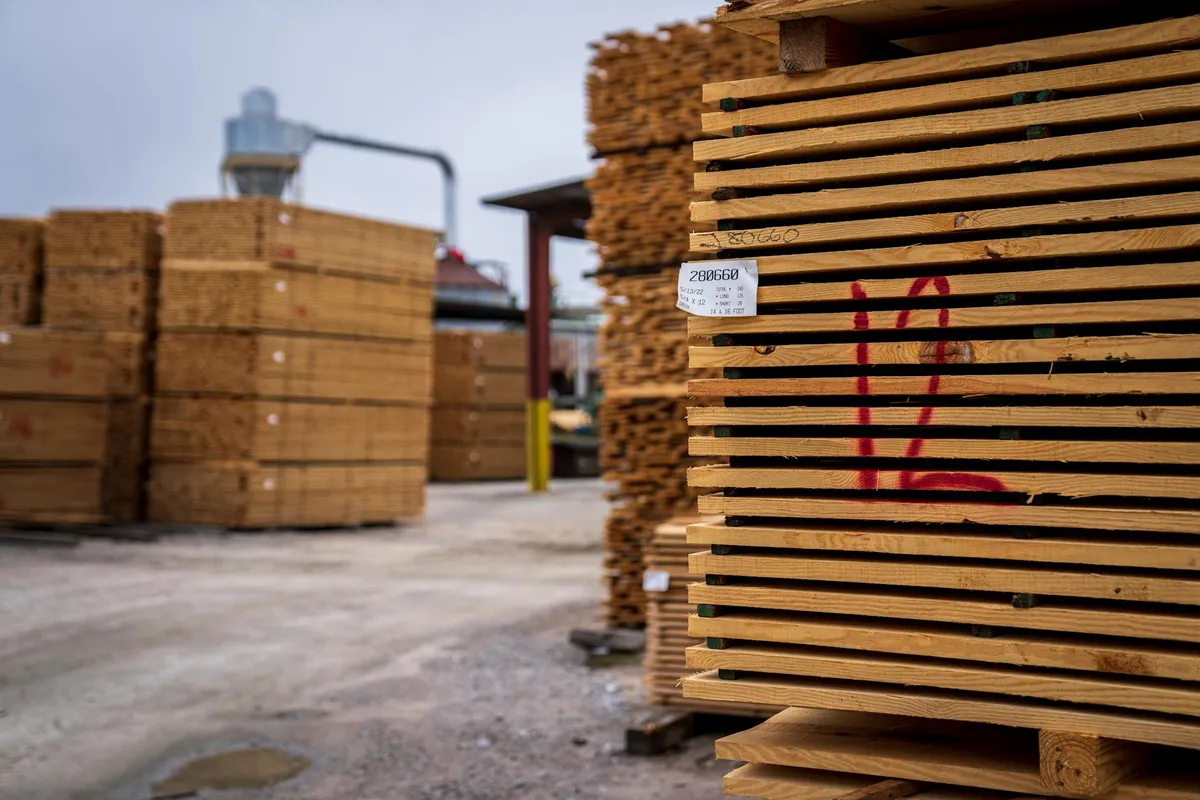
The cost premium for mass timber construction relative to comparable steel-frame or concrete buildings was a persistent structural barrier to wider adoption through most of the past decade. Project economics consistently showed mass timber options costing meaningfully more than conventional alternatives. The premium has compressed substantially over the past three years and the components of the compression are worth examining individually.
The supply chain maturation effect
The largest single factor in the cost compression has been supply chain maturation for cross-laminated timber and glued laminated timber products in North American and European markets. The capacity additions across multiple producers have moved the supply position from constrained to adequately supplied for most project sizes.
The pricing implications have been direct. CLT panel pricing has come down meaningfully across the past three years as competition between producers has intensified and as logistics costs have stabilized. Glulam pricing has followed a similar trajectory.
The supply chain maturation has also reduced lead times for project deliveries. Lead times that were sixteen to twenty-four weeks in 2021 are now commonly eight to twelve weeks for standard panel sizes. The reduced lead times have practical project-economics implications because they reduce the working capital and schedule risk associated with mass timber procurement.
The labor productivity effect
Construction labor productivity for mass timber assembly has improved meaningfully as more contractors have accumulated experience. Projects executed by experienced timber contractors now achieve assembly rates that would have been considered exceptional five years ago.
The productivity improvement traces to several specific factors. Contractor crews have developed standard work practices for panel handling, connection detailing, and sequencing that did not exist when mass timber was novel. Equipment optimized for timber assembly — including specific crane configurations and material handling tools — has become more widely available. The interface between mass timber primary structure and other building systems has been refined enough that the schedule integration is no longer a major source of delay.
The productivity gains have been substantial enough to materially affect project economics. The labor cost component of mass timber projects has compressed at rates that exceed general construction labor cost compression in the same markets.
The design optimization effect
Architectural and engineering practice for mass timber has matured in ways that have improved cost-efficiency. The early generation of mass timber projects often involved design approaches that were inefficient in their use of timber volume and connection complexity because the design teams were learning the material as they went.
Current generation projects benefit from the accumulated knowledge of how to design for mass timber efficiency. Panel sizes are optimized for both structural performance and shipping economics. Connection details have evolved toward solutions that minimize labor cost while maintaining structural performance. Lateral force resisting systems have been refined to reduce timber volume requirements.
The cumulative effect of these design optimizations is a meaningful reduction in the timber and steel quantities required for equivalent structural performance. This reduction translates directly to material cost reduction.
The code maturation effect
Building code provisions for mass timber have matured substantially over the past several years. The 2021 International Building Code introduced specific provisions for mass timber tall buildings that did not exist in earlier code cycles. Subsequent code updates have continued refining and expanding the mass timber provisions.
The code maturation has reduced the design and approval cost of mass timber projects. Projects that previously required performance-based design analysis and extensive engineering justification can now be designed under prescriptive code provisions in many cases. This reduces engineering hours and reduces project schedule risk.
The fire engineering particulars have been the most consequential code area for cost reduction. The code-recognized fire resistance ratings for mass timber assemblies have matured to the point that protection approaches that were previously contested are now standard. The associated cost of additional fire protection that was sometimes added beyond code requirements has reduced as the code requirements themselves have become more authoritative.
What the cost picture currently looks like
For a representative mid-rise multi-family project in a market where mass timber capability is reasonably established, the current cost picture is approximately as follows. Material costs for the primary structure are typically within five to ten percent of comparable concrete construction, with significant variation by specific project conditions. Labor costs for the primary structure are often lower than comparable concrete construction due to shorter assembly schedules. Schedule benefits often translate to reduced general conditions and financing costs. The aggregate cost premium for the building shell is in many cases now within zero to ten percent of conventional alternatives, compared to the fifteen to twenty-five percent premium that was typical five years ago.
The cost picture varies significantly by project type, market, and specific design parameters. Some project types continue to favor conventional construction on cost grounds. Some markets do not yet have the contractor capability to deliver mass timber competitively. The general direction is unambiguously toward cost parity, with significant remaining variation in how close to parity any specific project gets.
What this implies for project decisions
The compressed cost premium has changed the calculus for project decisions in ways that the design and development community has not fully absorbed.
For projects that previously rejected mass timber on cost grounds, a current evaluation may produce different conclusions. The cost gap that justified the rejection three years ago may no longer exist. Re-evaluating mass timber options on current cost data is worth the effort for many project types.
For projects in markets where mass timber capability is establishing, the contractor selection becomes more important to cost outcomes than it would be in mature markets. Projects executed by experienced timber contractors approach the favorable cost picture described above. Projects executed by contractors learning timber for the first time often face higher costs reflecting the learning curve.
For developers and design teams committed to mass timber for non-cost reasons (carbon, design quality, market positioning), the compressed cost premium reduces the value justification burden these decisions require. The financial case for mass timber is increasingly closer to neutral on a pure cost basis, with the non-cost benefits providing the actual value proposition.
What the next phase of cost evolution probably looks like
The cost compression trajectory is likely to continue but at slower rates than the past three years. The largest gains from supply chain maturation, design optimization, and code maturation have been captured. Future cost improvements will come from incremental gains across multiple dimensions rather than from the structural transitions that drove the past three years.
The factors that will most affect future cost evolution include continued capacity additions on the supply side, ongoing labor productivity improvements as contractor experience deepens, and potentially significant developments in industrial automation for timber assembly that some manufacturers are beginning to deploy.
Projects planned for delivery in 2027 and beyond should plan for cost economics that are at or near parity with conventional construction in markets with established mass timber capability. Projects in markets where capability is still developing should plan for the cost premium to compress as the local capability develops.
The fundamental shift represented by the past several years of cost compression is that mass timber is no longer structurally disadvantaged on cost in the way it was when the material was newer. The remaining cost differences are increasingly within the normal variation that any structural system would face across different markets and project conditions. This is the structural change that has the most significant implications for the future trajectory of mass timber adoption.